New York Series
Artist
Takeshi Kawashima
(Japanese, born 1930)
Date1967
MediumAcrylic on canvas
Dimensions36 × 36 in. (91.4 × 91.4 cm)
Frame Size: 36 3/4 × 36 3/4 in. (93.3 × 93.3 cm)
ClassificationsPainting
Credit LineGift of Dr. & Mrs. John M. Rainey, Jr., 1980
Object numberUAC353
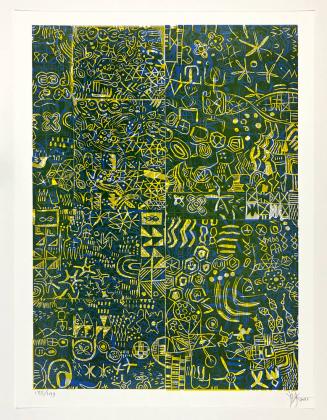
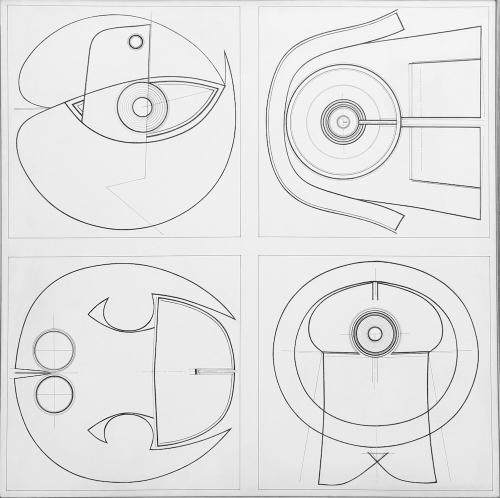
DescriptionArtist Takeshi Kawashima’s 1967, acrylic on canvas piece, New York Series, raises many questions upon first viewing, the most immediate being what exactly is it that we are looking at? What is it that these symbols are trying to convey to us? Could this be some sort of informational graphic from a science textbook? Or perhaps pictures from an instructional booklet on how to build a strange piece of furniture from Ikea? The speculation is endless, with more details popping out at you as you look, further complicating these forms as well as any notions you have as to what they could be. Subtle dashes on the lighter lines reveal themselves to you as you try to comprehend what you are seeing, multiple rings within rings suddenly appear to make themselves known to you for the first time, and yet feel as if they have always been there. Every line is precise and purposeful, with a perfect balance between organic shape and rigid cartographical notation. These shapes come so close to being something that one can recognize, such as an eye, an apple, a tower, or an animal, and yet they just as easily avoid any sort of categorization. Each symbol seems to share common traits, yet you know that they all must mean something different, if only you understood them. Each symbol resides on one square of a four-by-four grid, the background a subtle off-white color, with the edges of the grid as well as the center a slightly darker, almost pinkish color. Born in 1930, Kawashima graduated from the School of Fine Arts in Musashino, Tokyo, in 1955 and briefly taught art classes at the Yoyogi Art School before immigrating to the United States, where he has been fascinating people with his pictographs, like those seen in New York Series, ever since. His symbols, inspired by Japanese culture, Minimalism, and various Pop movements, echo the challenges of assimilation and cultural barriers. He breaks down these barriers by creating a universal system of symbols, which can change meaning when looked at as a group or as a single unit. Although this piece seems like an outlier in that every symbol shares the same color and background grid color, many of his symbols from other works are each painted a specific, bold color, or have a uniquely colored background within their grided square, adding a sort of colorful playfulness. Regardless of individual color, each symbol fits cohesively within the larger framework of symbols and stands in for universal archetypes of the natural world. These symbols invite you to ponder, to speculate, and to meditate on what you are seeing, and to compare them to how others see each shape, as there is no right or wrong answer.
Kawashima’s works have been displayed internationally, both in a group and solo, at the Hannah-Kent Gallery, Mitchell Algus Gallery, and Walter Wickiser Gallery in New York, as well as the Yamaso Art Gallery in Kyoto and the Kagawa Prefectural Culture Museum in Takamatsu. His work can also be found in the Museum of Modern Art, the Norton Simon Museum in Pasadena, and in the National Museum of Modern Art in Tokyo.
Written by Kayla Plenda
1. PFA Gallery, “Takeshi Kawashima,” Artsy.net, accessed March 24, 2025, https://www.artsy.net/artwork/takeshi-kawashima-untitled-grid
Collections