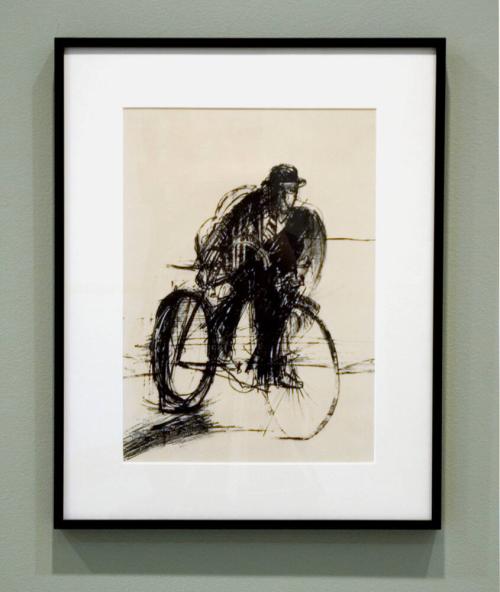
Bike Rider
Artist
Bradley Jones
(American, 1944-1989)
Date1968
MediumLithograph
DimensionsImage Size: 16 7/8 × 12 1/4 in. (42.9 × 31.1 cm)
Frame Size: 22 3/4 × 18 in. (57.8 × 45.7 cm)
ClassificationsPrint
Credit LineGift of Rex E. Lamoreaux
Object numberUAC2057
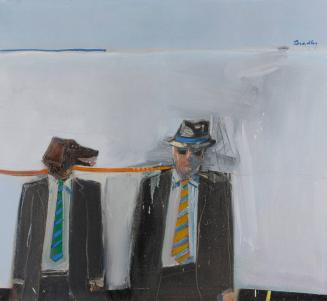
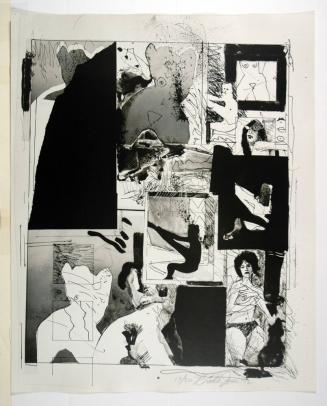
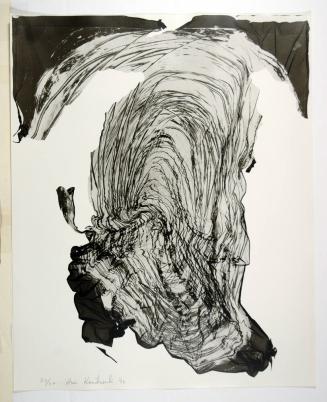
DescriptionOne thing that immediately catches the eye when viewing the 1968 lithograph, Bike Rider, is the expert use of sketchy, etched lines to convey forward momentum. What one is looking at is a man in a suit and tie on a bike, his destination unknown. All we know is that for a brief second or two, he has come into the viewer’s line of sight, and then just as quickly, he will have peddled away. The way that the artist has rendered this man and his bike resonates with this feeling of a brief encounter. His face, one half obscured by shadow and one half only a vague outline of eyes, lips, and nose, lets us know that he is indeed a bicyclist, but not much else. His body and clothing are similarly obscured, with only sketchy, dark lines to hint at the shape of bike and rider. The middle of his body is so sketchy and the lines so close together that he seems to fuse with the bike itself, becoming one entity. These chaotic lines also make it difficult to tell where the man’s legs are on the bike and give a sense of frenetic motion, as if we cannot pin down exactly where his legs are, as he is moving so swiftly. One can almost feel the slight back and forth of his body on the bike as he peddles. The artist of this piece, Bradley Jones, was a part of the Cass Corridor art movement in the early 1970s and received his Bachelor of Fine Arts and Masters of Fine arts at Wayne State University. At Kent State in Ohio, he also received a fellowship in 1969, and in 1970, he began to teach at Wayne State County Community College. Most of his art centers around scenes from Detroit and is influenced by the people he met or observed and things he saw while living there, along with sketches and photographs. Bike Rider, one of his earliest works, fits into his initial artistic phase of depicting simple subjects of everyday life, such as burst water pipes and pedestrians one would see on streets and sidewalks. He then moved on to figurative paintings of characters which were brightly colored and fantastical, featuring animal/human hybrids in a more playful style when compared to his later work, which utilized a more subdued color palette, and more distorted anatomy. Much of his artwork shows figures in ambiguous situations fraught with tension, where one is not quite sure whether what they are looking at is a benign slice of everyday life, or a scene that shows the moment right before something terrible happens. The limited color palette of black, grey, and blue lends itself to is ambiguous tone. Jones has said that it is up to the viewer to ultimately decide if these images of women are angels or prostitutes or if the woman at the beach with her male companion is out for a nice stroll or if she has a weapon behind her back.1
Wayne State has several of Jones’s artworks in their collection, four of them sketches, and two of them paintings.2 The Detroit Institute of Art also has two sketches and a fully painted piece, but they are not on display.3 His work has also been shown at Feigenson/Preston Gallery in Birmingham, Michigan in 1988. Jones passed away in 1989 but has left a lasting impression on the art world, especially for those in the Detroit Art Community.4
Written by Kayla Plenda
1. Manon Meilgaard, “Bradley Jones b. 1944 d. 1989: Corridor Painter,” Corridor Tribe, Jan. 14, 1987 https://corridortribe.com/obits/bradley_jones
2. “Bradley Jones,” University Art Collection, https://artmuseum.wayne.edu/people/729/bradley-jones/objects
3. “Bradley Jones,” Detroit Institute of Arts, https://dia.org/search/collection?keys=bradley%20jones
4. Manon Meilgaard, “Bradley Jones b. 1944 d. 1989: Corridor Painter”
Collections