
Reveries
Artist
Gelsey Verna
Date2005-2006
MediumLithograph and screen print on cut and folded paper
DimensionsPaper Size (Unfolded): 22 × 30 in. (55.9 × 76.2 cm)
Paper Size (Folded): 11 × 15 in. (27.9 × 38.1 cm)
ClassificationsPrint
Credit LineGift of Jeffrey Abt, 2023
Object numberUAC7533
DescriptionGelsy Verna was a beloved educator and an artist who “produced a broad and deep artistic record of her experience of moving through the world” through drawings, collages, paintings, prints, and photographs. Born in 1961 in Haiti, Verna also lived in the Congo for a few years before moving to Montréal in 1968. An alumna of the School of the Art Institute of Chicago, she received her BFA in 1988 and her MFA in 1990, both with concentrations in painting and drawing. She also studied in Maine and Germany before becoming a professor of visual arts at the University of Iowa and, later, the University of Wisconsin-Madison. Informed by her transnational child- and young adulthood, Verna meditated on the body, identity, and memory throughout her career; the phrase, “People whose bodies are not their own,” crops up frequently in her work and speaks to a wider engagement with postcolonial discourses.One of Verna’s most acclaimed bodies of work was inspired by a church fan bearing the portrait Martin Luther King Jr., which she appropriated extensively over several years and across multiple formats. She reimagined the civil rights leader with different hairstyles, clothing, and patterned backgrounds, or even in pop culture costumes; those images were also recycled and recombined in other works, together comprising a system of signification through juxtaposition. At times, the works read as idolatrous and contemplative; at others, they become destabilizing or even sacrilegious. For one commentator: “The aim was to make him more relevant, more alive...Beneath the disguises seems to lie the question of responsibility and commitment.”
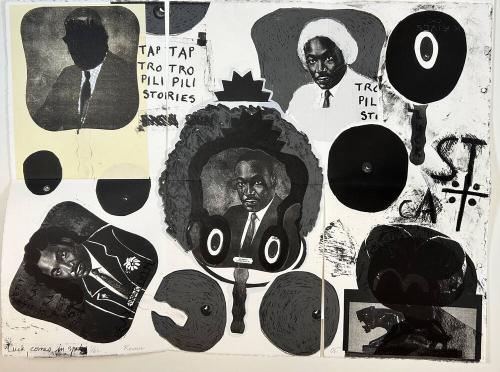
In this black and white collage Reveries, Verna embeds MLK Jr. fans amidst circular forms (which themselves contain isolated eyes), letters and words (repeated TAP / TRO / PILI / STORIES being the most prominent, with a secondary title “Luck comes in spades” lower left), and other found imagery. The portrait at center appears the most unaltered of the bunch, though the MLK Jr. figure is surrounded by Verna’s applications. The textured gray background appears as an oversized mane or head of hair and the two spiked forms appear to doubly crown the civil rights leader. One fan in the lower left is labeled “PRAYER ROOM,” and MLK Jr. wears a wig with long dark curls and a white boutonniere; one in the upper right appears to wear a white wig and suit over a grayed background. Verna has silhouetted the MLK Jr. figure in the upper left (apparently outfitting him with glasses, perhaps in reference to iconic photos of Malcolm X), his suit grayed and flattened. Verna also appears to have included another silhouette in the lower right, though the figure is entirely obscured beyond the suggestion of shoulders and a head (the Mickey Mouse ear-like shapes and arching brow appear copied from an earlier collage, in which MLK Jr.’s visage is more prominent). Further, this lower right ‘portrait’ is accompanied by a found image of a black panther sculpture, no doubt a reference to other Black liberation movements and civil rights initiatives. Are the Black Panther and potential Malcolm X references attempting to challenge, or even dethrone, the King at center? Perhaps, considering the title, Verna is summoning these historical figures and their ideologies (and how they are variously interpreted in public memory) in her own open-ended navigation of contemporary racism and persistent social illness. What if MLK Jr. had been more like the Panthers or Malcolm X, or formally partnered with them? What if MLK Jr. had the opportunity to grow old as an American leader, which is perhaps signified by the upper right image?
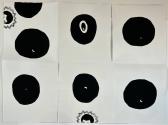
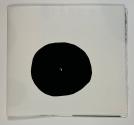
The collage itself is double-sided, with large black circle forms and two heads with (their own crown-like haloes) peeping from the margins characterizing the reverse. Verna once noted on her methodology: “The layering demonstrates consciousness…the image developing as if a train of thoughts, then rearranged and brought into focus.” This layered and fragmented quality—both conceptual and physical—again suggests Verna’s engagement with themes of diffraction and mutability, as well as the interpretative possibilities afforded by her collage practices.
Verna tragically passed in 2008 at the age of 46, but her impact continues to reverberate amongst students, peers, and institutions (for instance, her department at UW established the Gelsey Verna Project Space in her memory ), as well as through exhibitions, publications, and public and private collections.
Written by Sarah Teppen
1 https://www.harkawik.com/verna-pensee
2 https://www.gelsyverna.art/media/the-art-newspaper-nostalgia-will-happen-later
3 https://www.harkawik.com/verna-pensee
4 https://art.wisc.edu/galleries/gelsy-verna-project-space/