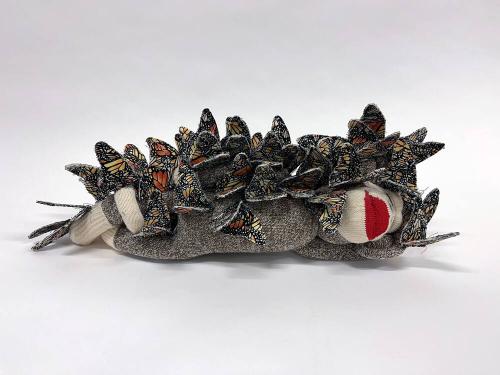
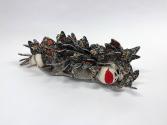
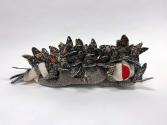
Butterfly Sock Monkey
Artist
Dolores Slowinski
(American)
Date2018
MediumPrinted textiles, socks and cotton batting
Dimensions8 × 21 1/2 × 9 in. (20.3 × 54.6 × 22.9 cm)
ClassificationsSculpture
Credit LineGift of Linda Downs, 2025
Object numberUAC7848.10
DescriptionOnce upon a time there was a very curious fruit bat who had a desire to taste bananas. The problem was that although he had wing bones that resembled a mammalian hand, his "thumb" was nothing but a claw. He could fly but could not grasp things. His desire to savor a banana drove him to frequently hang upside down in banana palms with the hope of persuading someone to share a banana with him.One morning, as he snuggled in his wings under the curve of a banana leaf, he heard a slight rustling and chittering. Opening one eye very slightly, he saw a monkey tail curling right in front of his nose. Blinking, he unfurled his wings and drifted up on a thermal of moist air so as not to disturb the monkey in the banana tree.
It was a delicate, diminutive female monkey who was about to peel a banana! The bat let out a squeak of delight that startled the little monkey and made her look up. Puzzled to see a fruit bat hovering overhead, she furrowed her brow in a quizzical expression. The bat slowly descended and sat poised quietly in an awkward stance on a nearby leaf his heart pounding in anticipation. His appearance had always frightened monkeys away. Yet this monkey seemed unfazed by his presence.
The female monkey spoke: "You are a fruit bat, aren't you?" The fruit bat answered: "Yes, I am. How did you know?"
She replied: "I've heard my parents talking about the bats that fly around at night feeding on juicy fruit, puncturing some of the best fruit and leaving it to rot in the morning sun. It makes a mess you know."
He apologized saying: "I'm sorry about the mess and leaving the fruit to rot, but you see there is no way that we can hold the fruit to eat it. We can only take a bite and suck out the juice. You are fortunate to have fingers and an opposing thumb that allows you to hold fruit and peel it if necessary."
At this point he almost fainted away because the female monkey had begun to pull back the skin on the banana releasing that tantalizing aroma and exposing the ripe fruit.
She saw the change that came over him, broke off a piece of the banana and laid it on the leaf near his mouth.
Tears rolled out of his now, dilated eyes, forcing him to squint against the light. At the same time saliva washed over his lips in a flood as he took the tiniest bite of the banana and collapsed.
He lay there on the leaf, unmoving. The little monkey was afraid to touch him but did not smell death upon him. She stayed near him admiring his short fur, flat nose, fine lips, and shiny wings until after the sun had set. Finally, his eyes opened again and his wings twitched to life.
"Thank you so much for sharing your banana with me. I've wanted to taste a banana for ever so long... but...well...since I couldn't peel one....and every monkey I approached ran away.
Thank you for not being afraid." he said.
"Oh, you are most welcome. Bananas are my favorite fruit. I come to this banana palm at least once a week. Would you like to meet me here and I could peel a banana for you?" she asked coyly. "You would do that?" he asked incredulously.
"We seem to share a craving. And sometimes I can't eat a whole banana. Your help would reduce the waste. And maybe you could show me where to find the juiciest mangoes?" she cleverly suggested.
"Oh yes! Of course I could. That would be splendid!" he replied with such enthusiasm that he flipped off the leaf and had to catch himself, fly up, drift down resettling alongside her.
So began a reciprocal relationship between the two juvenile members of the monkey and bat species.
Now as so often happens with juvenile individuals of any species...their minds and appetites soon matured from bananas to sex. The sucking sounds the two of them made eating juicy mangoes soon moved on to...well...bat kissing that soon had the little monkey wrapped in membranous bat wings and enthusiastic conjugal union.
Unprotected, cross-species sex leads to the same thing it does in most mammals...pregnancy. Yes, the little female monkey found out she was pregnant. Fortunately, both species gave birth to live young, so she was spared the embarrassment of laying an egg. Nevertheless, she was a bit anxious about what her parents would think when her baby unfurled its wings!
Neither she nor the fruit bat realized that sometimes cross-species individuals do not entirely benefit from such sexual abandon. Critical developmental and skeletal changes occur as the fetus develops. But these two were only focussed on having a healthy baby. They decided to name it Monkey Bat.
Monkey Bat was born on a humid still night in the middle of November. He was beautiful. He had his father's mustard-colored eyes and his mother's lips. He had his mom's arms, legs, and prehensile tail. His father was proud of his delicate wings and big ears. Both parents were stunned, however, when they saw that he had neither a thumb, nor a claw. Not only could he not peel a banana, he couldn't even cut a slit in the tough skin of a mango! There was a distinct possibility that he would be dependent on them his entire life.
As he grew, and he grew and grew, his parents realized he would be bigger than both of them put together. This became even more problematic as his wings developed imperfectly. Although their structure was sufficient to support him, the membrane of his wings had areas that were thinner than the rest. Wind currents could permeate the membrane making his flights as awkward and uneven as that of an injured pelican.
Not only that, but his night vision was also poor and he had no sonar. Night flying was out of the question. His appetite, however, was prodigious. Fruit was not enough to sustain his physical development. Monkey Bat fell in with a troop of baboons who introduced him to meat. Soon he began scavenging carcasses with hyenas and marabou storks.
It was these denizens of the abattoir who helped Monkey Bat find purpose in life. It took long discussions between his parents and a particularly unpleasant-looking marabou stork before his parents grasped the importance of the role Monkey Bat was destined to play in order to survive.
As a new species of individual, it would be difficult for him to find acceptance just anywhere, especially in the monkey or bat communities. The world of carrion eating and removal, however, was most accepting of any individuals available. Decomposition of dead creatures was swifter if the volume of flesh was dramatically reduced. The environment was cleaner. Disease was less likely to spread. The whole ecosystem benefited.
The old marabou stork assured Monkey Bat's parents that he was quite capable of lopping off a two pound chunk of fresh muscle for Monkey Bat to feast on and that dermestid beetles would clean up the remains. As a carrion eater, Monkey Bat would also be less likely to frighten off relatives at family gatherings. He would, in fact, be a great source of family unity during his visits as he would always be in need of grooming since his wings prevented him from grooming himself.
Monkey Bat grew into his job and shared many laughs with a pack of hyenas at the edge of the jungle. He didn't stay out long after dusk so as not to risk becoming carrion himself. On visits home he regaled his parents with stories of the flavors of different types of mammals as they fed him his favorite desserts: fresh banana and mango. He lived a happy, useful life and had several romantic liaisons, one with a chimpanzee, and another with a flying squirrel.
Money Bat Origin Story by Dolores S. Slowinski
It was just when he was about to plunge into his third relationship, this time with a ring-tailed lemur, that it occurred to him there was yet another aspect of being a cross-species individual. One that perhaps no one recognized but that, for now at least, would provide him with pleasure and delight without progeny: he was sterile.
Monkey Bat was very direct in explaining his sterility to his partners, reminding them that despite this shortcoming, they should still use protection to prevent the occurrence of sexually transmitted diseases. He became skilled in the sexual practices of many species. Eventually he was sought out to counsel other prospective cross-species couples and their families. His compassion and insight were beneficial to the social fabric of the entire countryside.
He decided to move on from the scrabbling, excrement covered company of vultures, marabou storks, hyenas and dermestid beetles (except to watch cape buffalo games with the old gang on Monday nights) to become a sex counselor. He sensed that many creatures felt cast aside and confused because of their sexual orientation. He understood how difficult life could be when someone was perceived as different or odd when who they were was not a matter of choice but a matter of being true to their nature. Soon word spread and many LGBTQI as well as cross-species individuals sought him out for guidance…so many species, so little time.
Collections