Niagara - New South
Artist
Michael Hall
(American, born 1941)
Date1995
MediumMixed media construction in artist's frame
Dimensions38 1/8 × 31 5/8 × 5 in. (96.8 × 80.3 × 12.7 cm)
ClassificationsMixed Media
Credit LineGift of Robert Scott Johns, 2025
Object numberUAC7844.01
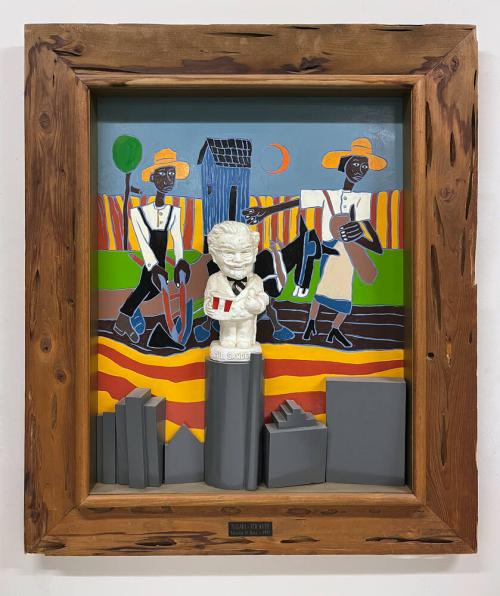
DescriptionArtist Michael David Hall has visited Niagara Falls many times; for him, the site is “America’s dumpster…where all our dreams, our myth of the frontier, myths of ourselves, the grandeur of ourselves, the hopelessness of ourselves, all goes into spray and smoke…You can grind your way up toward it in the mist, but you'll never really know as millions of tons of water are just crashing around you.” In the early 1990s, Hall took a historic view of the landscape and “dumped America into it,” which was then extrapolated into a series that investigated American social and historical narratives as it juxtaposed fine art and mass culture and consumerism. For commentator Vincent A. Carducci, “the Niagara gorge [was] appropriated conceptually to function as the ultimate container for the abundance of signs that constitute America’s cultural heritage.” By 1995, Hall appears to evoke this Niagara container through title alone. In Niagara – New South, Hall constructs a scene centered around an alabaster Colonel Sanders figurine holding a bucket of Kentucky Fried Chicken, a found object, standing atop a gray cylindrical pedestal. The lower margin of the composition is characterized by several other gray objects, all assembled over a painted background depicting a brightly colored rural scene. Two abstracted figures and a donkey appear to work a plot of farmland under a blue sky and a partially eclipsed orange sun; the man holds some sort of plow tool as he follows the donkey led by the woman down a rich soil path in front of a house structure with an orange and yellow-striped fence and a solitary tree. Altogether, the layered contrasts—between the white Col. Sanders and the Black farmers, his three- and their two-dimensionality, the found objects’ dearth of color against the vibrant background image, the silhouetted city skyline against the sparse rural landscape, the so-called New South in the foreground arising out of the Old South in the background, and even fast food versus the notion of ‘slow’ food—seem to comment on America’s legacies concerning racism and class struggle, as well as how such social structures continue to transform over time. It's almost as if a self-satisfied Col. Sanders has summited a skyscraper to relish his corporate empire; like all American institutions it is built on a legacy of slavery that continues in new forms. The masses continue to toil as they always have (and perhaps always will). If the very word “Niagara” is enough to summon a romanticized vision of America, Hall mobilizes it as a marker of critique. Here specifically, the dynamics in the “New South” should be scrutinized, especially as we continue to espouse the American Dream in public discourse.
Outside the Niagara works, Hall is a sculptor best known for his monumental constructions in steel and aluminum. He has exhibited widely and is represented in a number of permanent collections; Hall’s work can also be found in public spaces such as the Josephine F. Ford Sculpture Garden outside the College for Creative Studies and the Michigan Legacy Art Park near Frankfort. Born in 1941 in California, Hall was inspired early on by exposures in Los Angeles, particularly to the Watts Towers, the La Brea Tar Pits, and the Finish Fetish School of artmaking. After receiving his M.F.A. from the University of Washington (Class of 1964), Hall taught at the Universities of Colorado and Kentucky before moving to Michigan in 1970 to work as an artist in residence and head of the sculpture department at Cranbrook Academy of Art. Hall has remained in the Detroit area since, nurturing a career as an artist and educator as well as a notable author, curator, and collector with an expertise in American Scene and Regionalist art.
Written by Sarah Teppen
1 https://www.youtube.com/watch?v=B3cvGWEdX00
2 https://www.artforum.com/events/michael-hall-218474/
Note from the artist: NIAGARA – NEW SOUTH
Dear Kempf: Here is some background information on your recently acquired picture entitled Niagara – New South
The picture begins with a relief carved reproduction of a 1940 oil painting entitled Sowing which was painted by the African American painter, William H. Johnson. I am attaching a Xerox copy of a reproduction of the Johnson picture for your interest and reference.
My relief carved version of the Johnson image changes the plowed fields in the background of the original painting into the vertical cascade of water found in typical depictions of Niagara Falls. The striped field motif is then carried down into the lower center of my construction to suggest the great Niagara basin at the foot of the falls. The African American sharecroppers in the Johnson painting are thus swept up into a larger vision of the America traditionally symbolized by the Falls of Niagara.
Below the appropriated Johnson image, I have constructed a model architectural frieze that replicates the skyline of modern-day Atlanta, Georgia. The centerpiece of this frieze is a representation of the “Peachtree Center” office tower that dominates the Atlanta skyline. This tower (like Detroit’s Ren Cen) was designed by the architect, John Portman.
Atop the Peachtree tower, I have installed a plastic toy bank shaped in the image of Colonel Sanders (the founder of the Kentucky Fried Chicken restaurant chain). The Colonel looms up into the space of the field being plowed by Johnson’s farmers. Symbolically, a “new urban south” built by business and run by corporate power and money rises up to replace the old rural south of Johnson’s memory. Folk culture and folkways disappear in the face of a new corporate hegemony that is totally indifferent to traditional, regional identity save for its occasional efforts to exploit the idea of local culture through visual clichés or kitsch logos.
Around the entire image I have set a wide frame made from a distinctly southern wood – wormy cypress. This wood is from the swamps of the south and is distinctly a regional material that I deemed wholly appropriate to the southern theme of my construction. The liner between the frame and the image inside it has been painted gold in color – a nod to the idea of gold frames and the importance they confer on the pictures they contain through their very “gold-ness.”
Enjoy this piece my friend. I have always thought it to be one of my best Niagara theme works and am delighted that it has found a home in your collection.
Sincerely: Oct. 1, 2006