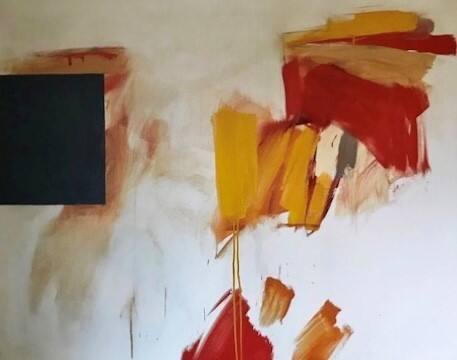
Abstract Composition
Artist
Donald Willett
(1928 - 1985)
Datec. 1965
MediumOil on canvas
Dimensions39 × 48 in. (99.1 × 121.9 cm)
ClassificationsPainting
Credit LineThe Estate of Harold and Sheila Cruger, 2021
Object numberUAC6879
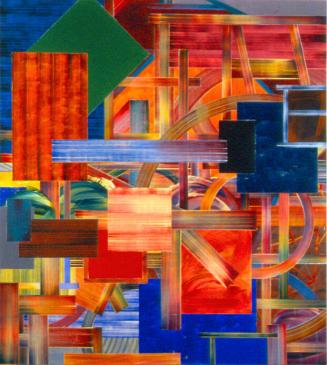
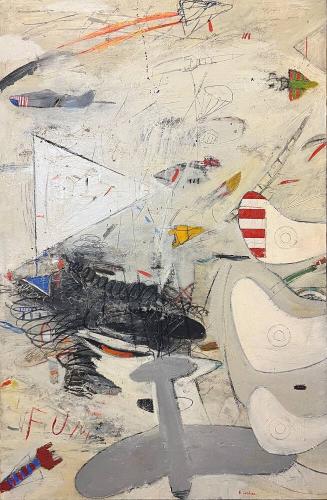
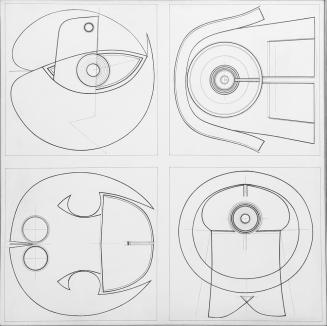
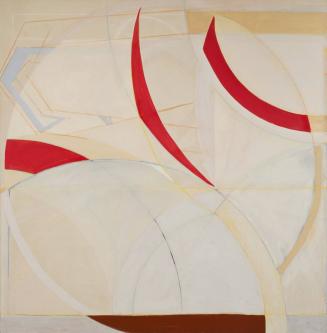
DescriptionArtist Donald Willett (1928 – 1985) began his artistic journey at the Cranbrook Academy of Art, graduating in 1957. He then went on to become a faculty member and painting department chair there from 1964 – 1968. Willet was an abstractionist who experimented with multiple painting modes and methods of contemporary painting from the 1950s and 60s. Pop art, optical art, and geometrical abstraction were just some of the styles he dabbled in. 1Willett’s paintings can be found in the Cranbrook Art Museum’s collection,2 as well as the Wayne State collection, which has six of his paintings, all of which are abstract compositions.3 Three of these pieces are more geometric, with one painting containing bold shapes in orange, yellow and black outlined in white, and connected in the middle of the piece by a hexagonal orange shape. The other is a canvas with an off white, almost blue, square with crisp, sharp lines, surrounded by a darker, almost denim blue which radiates out into an aquamarine blue around the edges. The last is an off-white canvas covered in thick, dark blue lines with a green and white geometric shape superimposed over the lines. His three other pieces are less geometric and more sketch-like, with loose brushstrokes in a limited, neutral toned palette that look like they have been put down with wild abandon.
His 1965 oil on canvas painting, Abstract Composition, whether intentional or not, features aspects from several of Willett’s other works in the collection, such as color scheme and distinct shapes. It combines geometric form with abstract brushstrokes, highlighting the stark contrast between the crisp perimeter of the black box on the upper right side of the canvas and the kinetic energy of the sporadic brushstrokes that smear and drip on the right side.
This black box stands out immediately, both for its perfectly straight and sharp lines, and because it is the darkest color on the canvas. It looks like it has been placed over some of the lighter, red-brown brushstrokes that are on that side of the canvas, and which seem as if they have migrated away from the right side of the composition. The placement of this box over the lighter brushstrokes gives the allusion that either someone has cut away the canvas and left a blank spot in the shape of a square or has put a patch of some sort over the canvas, covering up parts of the painting. The edge of the square lines up with the edge of the canvas, and this, along with the brushstrokes that look as though they continue off of the canvas, make it seem as though there is more to this piece, as if the viewer is looking at a portion of a wall.
Written by Kayla Plenda
1. “Collection Highlights,” Kalamazoo Institute of Arts, accessed Apr. 14, 2025, https://kiarts.org/wp-content/uploads/2021/05/Collection-Highlights-4.pdf
2. “Behind-the-Scenes Collections Wing Tour,” Cranbrook Art Museum, 2026, Accessed Apr. 2026, https://cranbrookartmuseum.org/tours/behind-the-scenes-collections-wing-tour/
3. “Artist Info: Donald Willett, University Art Collection, Accessed Apr. 14, 2026, https://artmuseum.wayne.edu/people/1511/donald-willett/objects
Collections